Client background and treatment choice
The client came in with a single concern: the appearance of pores across her central face. Makeup settled into them by mid-morning. Her history was straightforward: no active acne, no recent isotretinoin, no keloid scarring. Home care was sensible (gentle cleanser, vitamin C most mornings, a retinoid twice a week, SPF 50+ “most days”). A prior course of chemical peels had given modest, temporary texture improvement.
At consultation, her Registered Nurse mapped the concern zone by zone; the perinasal area and medial cheeks were most prominent. Suitability was confirmed through skin assessment, medication review, Fitzpatrick typing, and a documented discussion of downtime and realistic result range. A non-ablative fractional protocol was appropriate: lower downtime, lower pigmentation risk, well-suited to incremental change. The microcolumn-and-healthy-island mechanism is designed to support neocollagenesis and helps to improve the appearance of pores and surface texture over time.
Protocol
The course ran across [CLINIC TO CONFIRM 1] sessions at [CLINIC TO CONFIRM 2]-week intervals, within the category-standard four-to-six-week window. Each session ran 60–90 minutes including topical anaesthetic, the laser pass, and cool-down. Energy and density were graduated session by session. Home care was non-negotiable: daily SPF 50+, gentle cleanser and ceramide moisturiser for the first 72 hours, retinoids paused one week around each session, exfoliants held two weeks, and no saunas, hot yoga or pools for seven days post-treatment.
Phase by phase
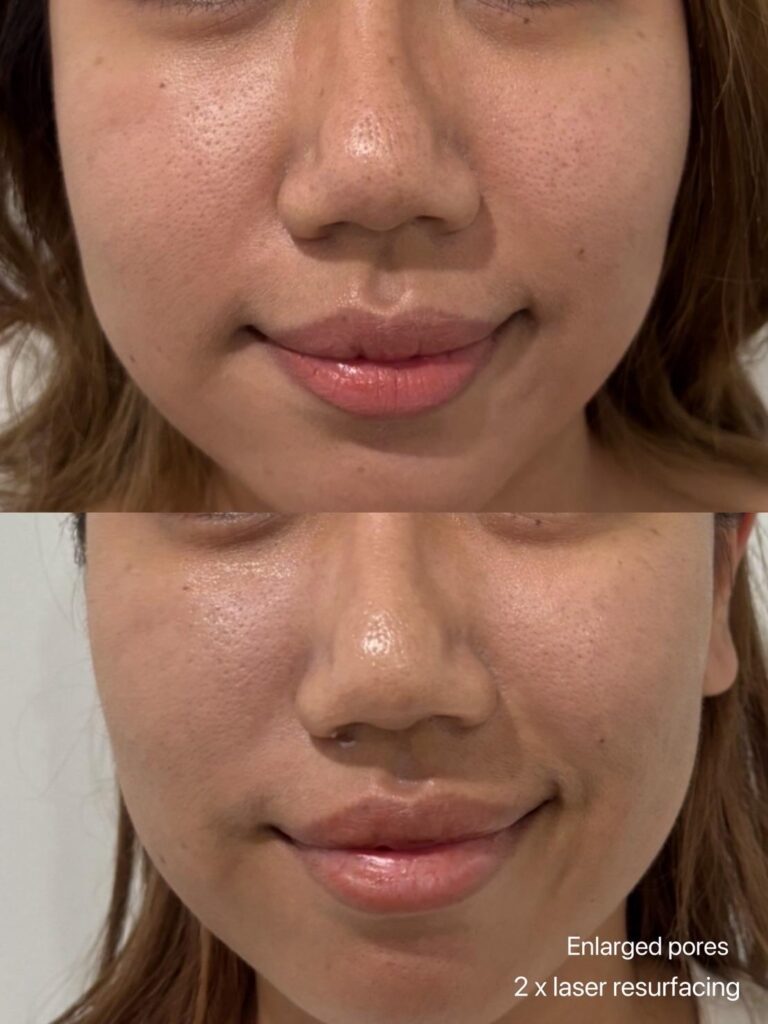
The Week 0 baseline showed visibly dilated pores across the medial cheeks and perinasal zone with slightly irregular texture under raking light. The first 24–48 hours after each treatment felt like a warm sunburn; by Day 2–3 the skin took on a sandpaper texture as micro-crusts formed, with speckled bronzing and micro-peeling through Days 3–5. By end of Week 1 only a residual pinkness remained: realistic non-ablative downtime, not no-downtime. Between Weeks 2 and 4 the client noticed a subtle smoothing; the appearance of pores read as less pronounced. Subsequent sessions followed the same rhythm, with peak visible change landing 8–12 weeks after the final session. The Week N frame shows the appearance of pores across the medial cheeks and perinasal area reading as less pronounced, with more even surface texture under matched lighting.
Maintenance
Non-ablative fractional results are maintained, not fixed: collagen turnover continues with age and sun exposure. A typical pattern is one session every 6–12 months, adjusted at review. Daily SPF 50+ is the single most important step after this course; in Brisbane’s UV environment it is non-negotiable.
What this may mean for others considering the treatment
Fractional laser resurfacing is not for everyone. It is set aside during active inflammatory acne, pregnancy or breastfeeding, and the clinic’s isotretinoin washout window, with careful parameter selection and test spots for Fitzpatrick IV–VI skin. Downtime is real: redness and flaking for several days is part of the treatment, and post-treatment SPF is the difference between a clean result and a pigmentary complication. Results unfold over 2–3 months as collagen remodels, and individual results vary.
Important information about this case study
Individual results vary. The images on this page show one client’s response to a specific treatment plan delivered at Flourish Skin and Laser Clinic. Your skin, concern, and response to treatment will be different.
Treatment performed: Fractional Laser Skin Resurfacing, a non-ablative fractional laser that delivers energy in a grid of microscopic columns, designed to stimulate the skin’s natural collagen and elastin remodelling and help improve the appearance of surface texture and pores over time.
Clinician: Registered Nurse, Flourish Skin and Laser Clinic (Sunnybank).
Common side effects disclosed at consultation include: redness for 24–72 hours, mild swelling, a sandpaper-like texture as the treated skin settles, micro-crusting and bronze speckling during days 3–5, transient sensitivity, and a risk of post-inflammatory hyperpigmentation, particularly in Fitzpatrick IV–VI skin. A full risk profile is reviewed with you in person before any treatment begins.
Suitability for fractional laser skin resurfacing is determined during a clinical consultation. This case study is not a recommendation, diagnosis, or clinical guarantee. It is a factual record of one client’s treatment course, published with their written consent.
Device / product regulatory status: The fractional laser used at Sunnybank is listed on the Australian Register of Therapeutic Goods under its Australian sponsor (ARTG listing [CLINIC TO CONFIRM 8]). The device is operated by Registered Nurses holding a current Queensland Cosmetic Laser Use Licence endorsed for skin rejuvenation under the Radiation Safety Act 1999.
Photo conditions: Both photographs on this page were taken under matched lighting, distance, angle, and device. No filters, beauty smoothing, or retouching have been applied. Original files retained on record.
Consent and withdrawal: This case study is published with the client’s specific written consent for use on the Flourish Skin and Laser Clinic website only. The client may request removal at any time by contacting enquiry@fskinandlaser.com.
Book a consultation at Sunnybank to discuss whether fractional laser skin resurfacing is appropriate for your skin.
We’ll walk you through the options, the downtime, and the realistic result range for your skin. No pressure to proceed.