Client background and why Pico
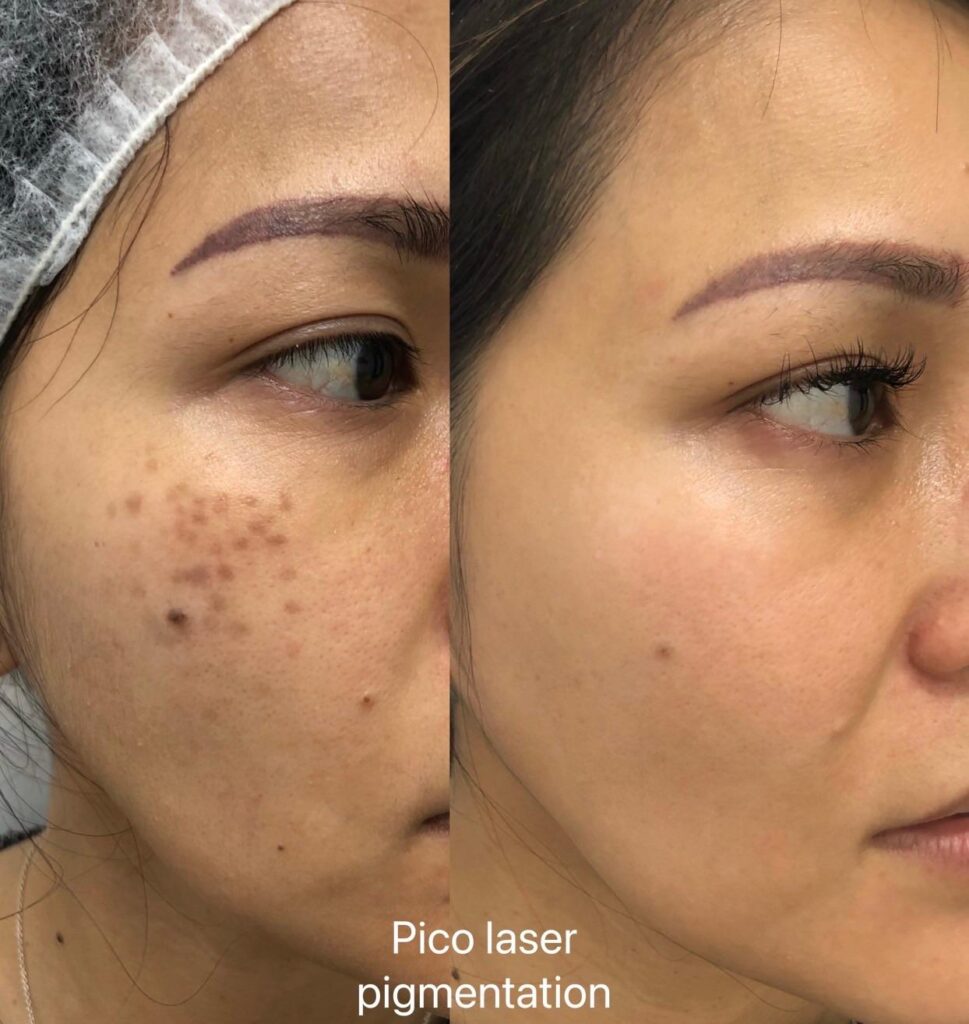
The client presented at Flourish Skin and Laser Clinic (Sunnybank) with diffuse sun-induced pigmentation across the cheeks and upper cheekbones, a mix of solar lentigines and scattered ephelides built up over years of Brisbane summers. A twelve-month pigment-corrector serum routine and two courses of superficial peels elsewhere had softened the background tone, but the discrete darker spots were largely unchanged.
Pico laser delivers pulses in the picosecond domain, short enough that the dominant mechanism becomes photoacoustic shattering rather than heat, fragmenting pigment clusters for clearance through the skin’s own pathways. For this client’s discrete, superficial lentigines, it was a considered fit. The Registered Nurse weighed other options during consultation, kept LDM and topical maintenance as adjuncts, and documented a full risk discussion (including the possibility of post-inflammatory hyperpigmentation, a real and common temporary outcome rather than a footnote).
The treatment plan
The plan was structured around a course of [CLINIC TO CONFIRM: number] sessions spaced [CLINIC TO CONFIRM: interval] apart, with a review point built in partway through. Treatments were deferred when recent UV exposure was noted, since elevated epidermal melanin increases the risk of unwanted pigmentary response. Numbing cream was offered ahead of each session. In-chair time was typically short. Broad-spectrum SPF 50+ was written into the home-care plan as non-negotiable from day one, and consent was reconfirmed at each photo capture.
The journey
Week 0 began with a full skin assessment (Fitzpatrick type, medical history, topicals, recent sun exposure, and photosensitising medications reviewed) and a standardised photograph under fixed studio conditions. Each session followed the same rhythm: cleanse, optional anaesthetic window, treatment, debrief. A mild frosted appearance over targeted spots was the expected immediate endpoint; treated spots typically darkened into a coffee-ground texture over the following days and shed naturally. Between sessions the protocol was simple: gentle cleanser, supportive moisturiser, strict SPF 50+, no active exfoliants on treated skin. Across the scheduled photographs, the treated pigment softened gradually. Deeper pigment lagged superficial pigment, as expected. Settings were adjusted across sessions where appropriate. Many clients on a similar treatment plan experience progressive improvement in the appearance of sunspots and background dyschromia. Individual results vary.
Maintenance and ongoing care
Pigmentation is cumulative. UV, heat, hormonal shifts and age all continue to influence how the skin presents. Maintenance is part of the plan, not an afterthought. For this client, ongoing care is daily broad-spectrum SPF 50+, a targeted topical regimen agreed at consultation, and a review at [CLINIC TO CONFIRM: cadence] to assess whether further in-clinic sessions are appropriate. Any new or changing pigmented lesion is referred back for clinical assessment rather than treated by default.
What this means for people considering Pico laser
Pico laser is designed to target pigment at the source, but a course of treatments is typically required and suitability depends on skin type, pigment depth, and response. Recent sun exposure, pregnancy and breastfeeding, certain medications, active skin conditions, and a history of keloid scarring are all reasons to defer or rule treatment out. The progression in this client’s captured photos reflects one response to one treatment plan, delivered by a Registered Nurse under controlled conditions. Your skin and response will be different.
Important information about this case study
Individual results vary. The images on this page show one client’s response to a specific treatment plan delivered at Flourish Skin and Laser Clinic. Your skin, concern, and response to treatment will be different.
Treatment performed: Pico Laser (Pigmentation), a picosecond-domain laser treatment that delivers ultra-short pulses designed to fragment pigment clusters for clearance by the body’s natural processes.
Clinician: Registered Nurse, Flourish Skin and Laser Clinic (Sunnybank).
Common side effects disclosed at consultation include: transient redness and swelling, a temporary “frosted” or darkened appearance of treated spots, pinpoint bleeding, crusting and flaking for several days, temporary sensitivity, and post-inflammatory hyperpigmentation (more common in darker skin types). A full risk profile is reviewed with you in person before any treatment begins.
Suitability for Pico Laser is determined during a clinical consultation. This case study is not a recommendation, diagnosis, or clinical guarantee. It is a factual record of one client’s treatment course, published with their written consent.
Device / product regulatory status: [CLINIC TO CONFIRM: {DEVICE NAME} is registered under {SPONSOR} ARTG listing {NUMBER} / listed on the Australian Register of Therapeutic Goods]. Performed by Registered Nurses licensed under Queensland’s Radiation Safety Act 1999.
Photo conditions: Both photographs on this page were taken under matched lighting, distance, angle, and device. No filters, beauty smoothing, or retouching have been applied. Original files retained on record.
Consent and withdrawal: This case study is published with the client’s specific written consent for use on the Flourish Skin and Laser Clinic website only. The client may request removal at any time by contacting enquiry@fskinandlaser.com.
Book a consultation at Sunnybank to discuss whether Pico Laser is appropriate for your skin (Pico Laser is available at our Sunnybank clinic only).
Sunnybank (Pico Laser available at Sunnybank only).