Client background and why RF microneedling
The client came to Flourish Skin and Laser Clinic with textural unevenness across the cheeks and early signs of laxity along the lower face. A home regimen of retinoid and peptide serums had refined surface tone. The deeper structural concerns had not shifted. During consultation, the Registered Nurse reviewed skin history, medical background and Fitzpatrick classification, then talked through RF microneedling as an option for this combination of concerns.
RF microneedling combines fine microneedles with bipolar radiofrequency energy. The needles create controlled microchannels, then deliver RF energy into the dermis. The controlled heat is designed to stimulate collagen and elastin remodelling over the weeks that follow. Flourish uses two RF microneedling platforms across its two locations (Morpheus 8 at Sunnybank and Quadessy at Toowong), and the clinician selects the device based on skin type, concern depth and patient goals. A full risk discussion was documented. This covered redness, pinpoint bleeding, transient grid marks, mild swelling, post-inflammatory hyperpigmentation, and two to five days of visible downtime.
The treatment plan
A course of [CLINIC TO CONFIRM: number] sessions was scheduled at intervals of [CLINIC TO CONFIRM: weeks]. This sits within the category standard of three to six sessions spaced four to six weeks apart. Multiple sessions are required; a single session does not complete the treatment course. Topical numbing cream was applied 30 to 45 minutes before each session. Retinoids, AHAs and BHAs were paused for five to seven days post-session. Daily broad-spectrum SPF 50+ was part of the home-care plan from the first session onward. Treatments were deferred when recent UV exposure was noted. Consent was reconfirmed in writing at each photograph.
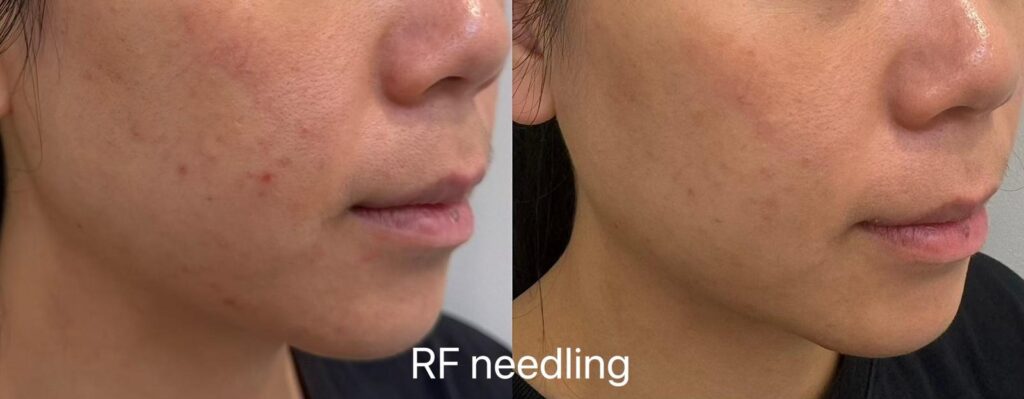
Sessions and recovery
Week 0 began with a full skin assessment and a standardised photograph under fixed studio conditions. Each session followed the same sequence: cleanse, numbing window, treatment, post-treatment balm, debrief. Redness was expected in the first 24 to 72 hours. A faint grid pattern was visible on some clients during that window. Most clients return to routine skincare within a week. Collagen remodelling builds over time, so the final photograph was captured at least 12 weeks after the last session. Across the scheduled photographs, skin texture along the treated areas softened and firmness along the lower face improved. Many clients on a similar treatment plan experience improvement in the appearance of textural unevenness and mild laxity. Individual results vary.
Maintenance and ongoing care
Collagen remodelling is not a single event. UV, age, hormonal shifts and lifestyle continue to influence how the skin presents over time. For this client, ongoing care is daily broad-spectrum SPF 50+, a targeted topical regimen agreed at consultation, and a review at [CLINIC TO CONFIRM: cadence] to assess whether a maintenance session is appropriate. A single maintenance session every 12 months is common practice. It is not a strict rule.
What this means for people considering RF microneedling
RF microneedling is designed to stimulate collagen and elastin remodelling at depth, and multiple sessions are required to complete the treatment course. Suitability is individual. It depends on skin type, concern, medical history and response. Reasons to defer or rule treatment out include active acne or infection at the treatment site, a history of keloid or hypertrophic scarring, pregnancy and breastfeeding, recent isotretinoin use, photosensitising medications, pacemakers or implanted electronic devices, metallic implants in the treatment area, and active herpes simplex at the site. The progression shown in these photographs reflects one response to one treatment plan, delivered by a Registered Nurse under controlled conditions. Your skin and response will be different.
Important information about this case study
Individual results vary. The images on this page show one client’s response to a specific treatment plan delivered at Flourish Skin and Laser Clinic. Your skin, concern, and response to treatment will be different.
Treatment performed: RF Microneedling, a fractional bipolar radiofrequency microneedling treatment that delivers controlled heat into the dermis, designed to stimulate the skin’s natural collagen and elastin remodelling over the weeks that follow.
Clinician: Registered Nurse, Flourish Skin and Laser Clinic ([CLINIC TO CONFIRM: Sunnybank/Toowong]).
Common side effects disclosed at consultation include: redness and warmth for 24 to 72 hours, pinpoint bleeding, mild swelling, a transient grid pattern, skin tightness and dryness, mild flaking, temporary sensitivity, bruising, cold sore reactivation in clients with a history of herpes simplex, and post-inflammatory hyperpigmentation (a real and more common consideration in Fitzpatrick IV to VI skin, not a footnote). A full risk profile is reviewed with you in person before any treatment begins.
Suitability for RF Microneedling is determined during a clinical consultation. This case study is not a recommendation, diagnosis, or clinical guarantee. It is a factual record of one client’s treatment course, published with their written consent.
Device / product regulatory status: Flourish uses two RF microneedling platforms across its two locations. [CLINIC TO CONFIRM: select the option matching the device used for this client]:
- Morpheus 8 (Sunnybank): used under the Australian sponsor InMode Australia Pty Ltd’s TGA-listed radiofrequency skin-treatment system (ARTG 331820, Class IIb) and related applicator tip entries. There is no dedicated ARTG entry under the Morpheus 8 brand name; the platform is registered at the sponsor level.
- Quadessy (Toowong): registered on the Australian Register of Therapeutic Goods as a multi-modality skin surface treatment system (ARTG 500185, Class IIb). Sponsor: Classys Australia Pty Ltd.
Treatment is performed by Registered Nurses at Flourish Skin and Laser Clinic.
Photo conditions: Both photographs on this page were taken under matched lighting, distance, angle, and device. No filters, beauty smoothing, or retouching have been applied. Original files retained on record.
Consent and withdrawal: This case study is published with the client’s specific written consent for use on the Flourish Skin and Laser Clinic website only. The client may request removal at any time by contacting enquiry@fskinandlaser.com.
Book a consultation at Sunnybank and Toowong to discuss whether RF Microneedling is appropriate for your skin.